| Foothills Guitar Duo |
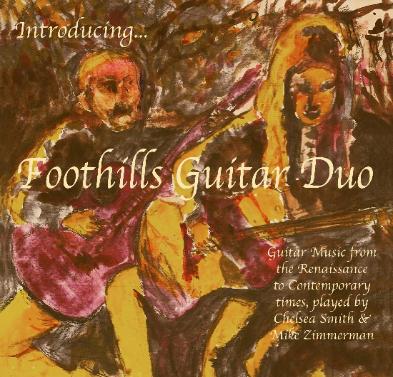
Our new CD...
Recorded in September-November
of 2012, this CD was a lot of work
and a lot of fun for us! We wanted
to create a CD that was as close to
one of our performances as
possible, so in each session we
recorded us playing at the same
time--not multi-tracking separate
parts of each piece. This gives you
a sense of what one of our
performances is like. You'll hear
some string squeaks and buzzes,
just like you would at a live
performance, and we think it makes
it sound more personal. We hope
you do too!
We had such limited space on the
CD cover and wallet jacket, we
couldn't add any notes on the
pieces. Here are some notes for
the pieces and some of our
thoughts about playing them.
of 2012, this CD was a lot of work
and a lot of fun for us! We wanted
to create a CD that was as close to
one of our performances as
possible, so in each session we
recorded us playing at the same
time--not multi-tracking separate
parts of each piece. This gives you
a sense of what one of our
performances is like. You'll hear
some string squeaks and buzzes,
just like you would at a live
performance, and we think it makes
it sound more personal. We hope
you do too!
We had such limited space on the
CD cover and wallet jacket, we
couldn't add any notes on the
pieces. Here are some notes for
the pieces and some of our
thoughts about playing them.
Music from the Renaissance era:
[1] Nonesuch. This anonymous melody comes from the Renaissance, although our version
is a bit more updated. We play this with the accompaniment based on the version on the
Suzuki method Book 3 CD.
[2] Greensleeves. Another anonymous piece that was well-known already in Renaissance
times.
[3] Robinson's May. Thomas Robinson (1560-1609) was a well-known lutenist who
published among other things "The School of Musicke" in 1610.
[4] Italian Dance. Hans Neusidler (1508-1563) was a German lutenist, music teacher and
lute maker. He was a prolific publisher of eight books of lute music between 1536 and
1549. He apparently was a prolific parent as well--it is said he fathered 13 children with his
first wife, then another four with his second...! This popular dance starts in duple time
(4/4), then changes to triple meter (3/4), making for an interesting dance and a fun tune to
play.
is a bit more updated. We play this with the accompaniment based on the version on the
Suzuki method Book 3 CD.
[2] Greensleeves. Another anonymous piece that was well-known already in Renaissance
times.
[3] Robinson's May. Thomas Robinson (1560-1609) was a well-known lutenist who
published among other things "The School of Musicke" in 1610.
[4] Italian Dance. Hans Neusidler (1508-1563) was a German lutenist, music teacher and
lute maker. He was a prolific publisher of eight books of lute music between 1536 and
1549. He apparently was a prolific parent as well--it is said he fathered 13 children with his
first wife, then another four with his second...! This popular dance starts in duple time
(4/4), then changes to triple meter (3/4), making for an interesting dance and a fun tune to
play.
Music from the Baroque era:
[5] King William's March. Jeremiah Clarke (1674-1707) was an English composer and
organist. After his death several of his works were erroneously attributed to Henry
Purcell, another English composer. Clarke is best remembered for a popular keyboard
piece "Prince of Denmark's March," which is commonly called the "Trumpet Voluntary,"
and is often performed at weddings. The piece we're playing here (King William's March)
also evokes the sound of trumpets...
[6] Bouree. George F. Handel (1685-1759) probably needs no introduction...as one of the
most famous composers of the Baroque, he is as well-known today as he was in his own
time. Composer of the oratorio "Messiah" and many other hugely popular works, he left
his native Germany for England where he became very successful.
[7] Minuet. Georg Telemann (1681-1767)
[8] Menuet en Rondeau. Jean Philippe Rameau (1683-1764)
[9] Minuet. J. S. Bach (1685-1750)
organist. After his death several of his works were erroneously attributed to Henry
Purcell, another English composer. Clarke is best remembered for a popular keyboard
piece "Prince of Denmark's March," which is commonly called the "Trumpet Voluntary,"
and is often performed at weddings. The piece we're playing here (King William's March)
also evokes the sound of trumpets...
[6] Bouree. George F. Handel (1685-1759) probably needs no introduction...as one of the
most famous composers of the Baroque, he is as well-known today as he was in his own
time. Composer of the oratorio "Messiah" and many other hugely popular works, he left
his native Germany for England where he became very successful.
[7] Minuet. Georg Telemann (1681-1767)
[8] Menuet en Rondeau. Jean Philippe Rameau (1683-1764)
[9] Minuet. J. S. Bach (1685-1750)
Music of the Classical era:
 |
 |
 |
 |
[10] Sonatina. Thomas Attwood (1765-1838)
[11] Rondo. Anton Andre (1775-1842)
[12] Allegretto (Op. 53, II "Le Premier Pas Vers Moi"). Fernando Sor (1778-1839)
[11] Rondo. Anton Andre (1775-1842)
[12] Allegretto (Op. 53, II "Le Premier Pas Vers Moi"). Fernando Sor (1778-1839)
Folksongs from around the world...
[13] Todos a mirar (Spain)
[14] Como quires que te quiras (Leon, Spain)
[15] Mareta, Mareta (Valencia, Spain)
[16] El Marques de Mochales (Leon, Spain)
[17] La Sinda (Spain)
[18] Ay como vive Don Ramon (Spain)
[19] Traveller's Song (Canada)
[20] The Oak Tree (Russia)
[21] Goda Gosse! (O. Ahlstrom, 1756-1835, Sweden)
[14] Como quires que te quiras (Leon, Spain)
[15] Mareta, Mareta (Valencia, Spain)
[16] El Marques de Mochales (Leon, Spain)
[17] La Sinda (Spain)
[18] Ay como vive Don Ramon (Spain)
[19] Traveller's Song (Canada)
[20] The Oak Tree (Russia)
[21] Goda Gosse! (O. Ahlstrom, 1756-1835, Sweden)
This page is still under construction...
Please excuse the partial entries!
Check back often to see the updates...
Please excuse the partial entries!
Check back often to see the updates...